(421)

Prem Krishnamurthy explores how art and design can be agents of transformation for individuals, communities, and institutions. This manifests itself across events, exhibitions, images, performances, publications, systems, talks, texts, and workshops (+ karaoke!). He received the Cooper Hewitt’s National Design Award for Communications Design in 2015, and Bard College’s Center for Curatorial Studies acquired his professional papers in 2019. In addition to directing design studios, establishing art institutions, organizing large-scale exhibitions, and teaching widely, he has also authored several books. These include P!DF (2017–2020), On Letters (2022), and Past Words (2024), an anthology of his writing and experimental curatorial projects.
(422)
(423)
Well, really fourth or fifth, but who’s counting?
(424)
And, if you count this current edit, we’re already quite a bit further in than that.
(425)
FWIW I love how you’re using footnotes in such an active way on the website.
(426)
I’ve been saying to friends recently that I think in nested footnotes, so it’s great to have an opportunity to perform this in writing.
(427)
The first submitted version of this essay was many times as long as the current draft, and with an exceedingly complex structure. Imagine: something like nine levels of nested footnotes! Perhaps brilliant, but definitely a true mess.
(428)
A previous draft:

(429)
As it turned out, that approach was so knotted up that even I could barely decipher it. After hours of editing, I’ve come back down to something more manageable. In the creative process, you sometimes have to venture through the storm to come out on the other side.
(430)
At certain moments, I seem to connect nearly everything to bumpiness. The connection of ideas, the tangling up of associations, is also a relevant way to think about what I’m trying to do with this essay.
(431)
I really hate mosquitos. As a child I wanted to become a research scientist to completely eradicate them as a species, until I realized that by killing all the mosquitos, all the frogs would die, and then the snakes, and then the … you get the point. I guess it’s all a web.
(432)
On the other hand, I mostly really like spiders, because they kill other bugs! What if there were a world in which we all get to be friendly spiders?
(433)
I recently heard about a canonical Pina Bausch performance called Cafe Müller. The person who described this piece to me reverently described Bausch, careening through a fully set up cafe, with her eyes closed, amid the imminent danger of crashing into a chair or a table or shattering glass. In a perfectly choreographed scene, her company removes the chairs and obstacles at the last moment, averting a tragedy. The storyteller was filled with reverence for this collective action. My first response was that it sounded like quite an act of ego, to move boldly through the world with eyes intentionally closed and assume that others would move things out of her way. I haven’t watched the video, but I encourage you to do so and find your own interpretation.
(434)
(435)
Entanglement and dependency on others is often framed as negative within a colonialist, capitalist world that sells us the aspiration to be solo, alone, autonomous individuals. What better method to divide and conquer?
(436)
Including me.

(437)
He’ll always be “Steffie” to me, since our time as students in the 1990s in Berlin.
(438)
It’s so wonderful that my parents now come to nearly all of my public events—true familial entanglement. I try to hold the personal close to my professional life, to keep me honest.
(439)
No shade intended, but they did not come to much of what I did in the early years of my career. I think because they did not understand at all what their son was doing with his life instead of becoming an engineer or such. The good news is: everyone can transform, if only they let themselves.
(440)
In this diagram, it shows what the brain’s activity looks like when the Default Motor Network is suppressed—something that happens through psychedelics, extreme sports, Zen meditation, and other activities. Interestingly enough, it’s also similar to the brain scans of young children. Essentially, in any of these states, the brain is able to associate things that are typically kept separate by the conscious operations of thinking.

(441)
Reminds me of a Maypole. Do you have any other associations?

(443)
We commissioned the ace photographer Hari Adivarekar to capture the whole day long event that this was part of, Ways of Showing Up. Without his photographs, I probably wouldn’t remember as much of the event. As a participant—even when you are also the organizer—you only ever really observe a small slice of the whole experience.
(444)
The Gift was first recommended to me by Rob Giampietro.
(445)
See also Marcel Mauss’s The Gift, the starting point of Hyde’s text.
(446)
Amanda-Li and Siri: in writing this down, I realize now that this whole text is really a gift to you two. You two have been such dear friends and colleagues over the past years. Since we first met, you both understood what it is I do. And have been persistent in inviting me to collaborate with you. The act of commissioning a text is a gift to another person, a space to think through practice. Thank you so much!
(457)
Two (or three) Tangles
Essay by Prem Krishnamurthy
Cover illustration by Nejc Prah
October 2024

Dear Amanda-Li, Bethany, Peter, and Siri,
Thanks again for your flexibility on the deadline for this essay! I know, it’s funny that we’ve been trying to work together on something for POST for… years? I’m not even sure how many. Although there are so many overlaps in our respective thinking and making, the timing was always too tight, the circumstances never quite right.
I must admit: Even when you asked me to write this time, I was so overwhelmed that I batted away your inquiry pretty quickly. But you did a good job of luring me in! The topic of “Tangle” is great, you were right on to say that it’s very connected to many strands of my thinking and work. Once I got over some writer’s block and threw out thousands of words of “trying to make a design essay on the topic of ‘Tangle’ sound good for designers and others” and just decided to write the second version of the text as a set of letters while on a 38-minute commuter train, it mostly flowed. Soon, I had a first full draft on the topic of “Tangle.” And there were even a handful of footnotes, just like you requested. But no, no, this was definitely not enough for my brain! I decided to add and add and add to it, making a text that was insanely unruly. Thankfully, though, even excessively-complex things can sometimes smooth themselves out.
Have you ever read the book Messy by Tim Harford? Tbh, I mostly read the introduction, that awesome opener about the confusion and near-cancellation of Keith Jarrett’s Köln concert, maybe a handful of chapters more. But what I did digest definitely resonated with me. How messiness, uncertainty, chaotic thinking, complex and unresolved creative processes, can all be instigators for a new thing. They are unavoidable and might be better embraced. Tangles (of ideas, of people, of situations) seems to be my (our?) collective mode these days.
I’ll start with what I know: For me, tangles relate to the concept of “bumpiness.” This is the idea that art and design can introduce generative friction to slow down the breakneck pace of our consumptive world. For whatever reason, I connect these two ideas. Maybe, a tangle is also a thing that slows things down, but less in a linear path, more in a many-directonal web. Like a mosquito caught by a spider.
Working further from this, maybe imperfect, metaphor: What if a tangle slows things down because this web—these semi-visible strands that connect us to other people, objects, creatures, spirits—makes it impossible to operate as a solo autonomous being who strides through the world in big steps? Instead, perhaps it shows that we are connected to others in ways that may sometimes appear limiting yet that also create the very possibility of living fully.
The deep implications of being tangled up were demonstrated—quite literally—by my close friend and collaborator Stephen Hanmer D’Elía in a recent event I organized with him called Un-familia-r. Stephen, a veteran child therapist, policy planner, and consultant, facilitated an experimental group workshop with a foundational conceit: The event was conducted entirely in Spanish, a fact intentionally left undisclosed until the program kicked off. An element of surprise, of defamiliarization. This simple tweak of format allowed those of us who did not speak Spanish to get closer to understanding what belonging to a non-dominant language group might feel like.
Stephen started by leading us in an embodied game that began mostly without words. About twenty of us stood in a circle in a dance studio at The Clemente, Department of Transformation’s current abode. Steffie held in his hands a large spool of colored yarn. He took hold of one end of the yarn, and then tossed the rest of it to someone standing halfway across the circle. In Spanish (with one of the participants translating impromptu), he explained that each of us should grip a piece of the yarn and continue by passing the rest of the roll to another person.
Wordlessly, but with some laughter, we began to throw the yarn across the circle, creating an asymmetrical crisscross of color and connections. My dad, participating in the workshop along with my mom, tried to toss the yarn to me—but it fell to the ground. I went into the circle to help get it, held onto my part, and threw it further. By the time we had finished the circle, we had what looked like a network diagram or one of those diagrams in Michael Pollan’s How to Change Your Mind of how an fMRI of a brain on psilocybin looks.
Steffie instructed us (still in Spanish) to each step or lean backwards. Within a moment, the circle of yarn became taut as each of us pulled and strained, the yarn stretching. A moment of tension: Would it snap?
Luckily, no. Steffie then asked us to come into the center of the circle, to each bring our respective section of the yarn to touch each other. The entire circle dropped to the floor limply. After this moment of slack, we all returned to our original positions. Next, he asked us to all begin to walk in a circle. Each of us had to focus on motion and keeping the string in our hands, as it tightened and loosened and threatened to get knotted up with each step. After a couple of wondrous minutes of giggling enmeshing, he instructed us to all let the string drop. A moment of pause afterwards, and then we moved on to the next activity in his multi-part workshop.
Of the whole two-hour event, this particular physical activity stays with me. I have no pictures of it, but many mental images. And these images connect it with another recent tangle I both organized and experienced, TASK, a project by the artist Oliver Herring. Thankfully, I do happen to have some good images of it:
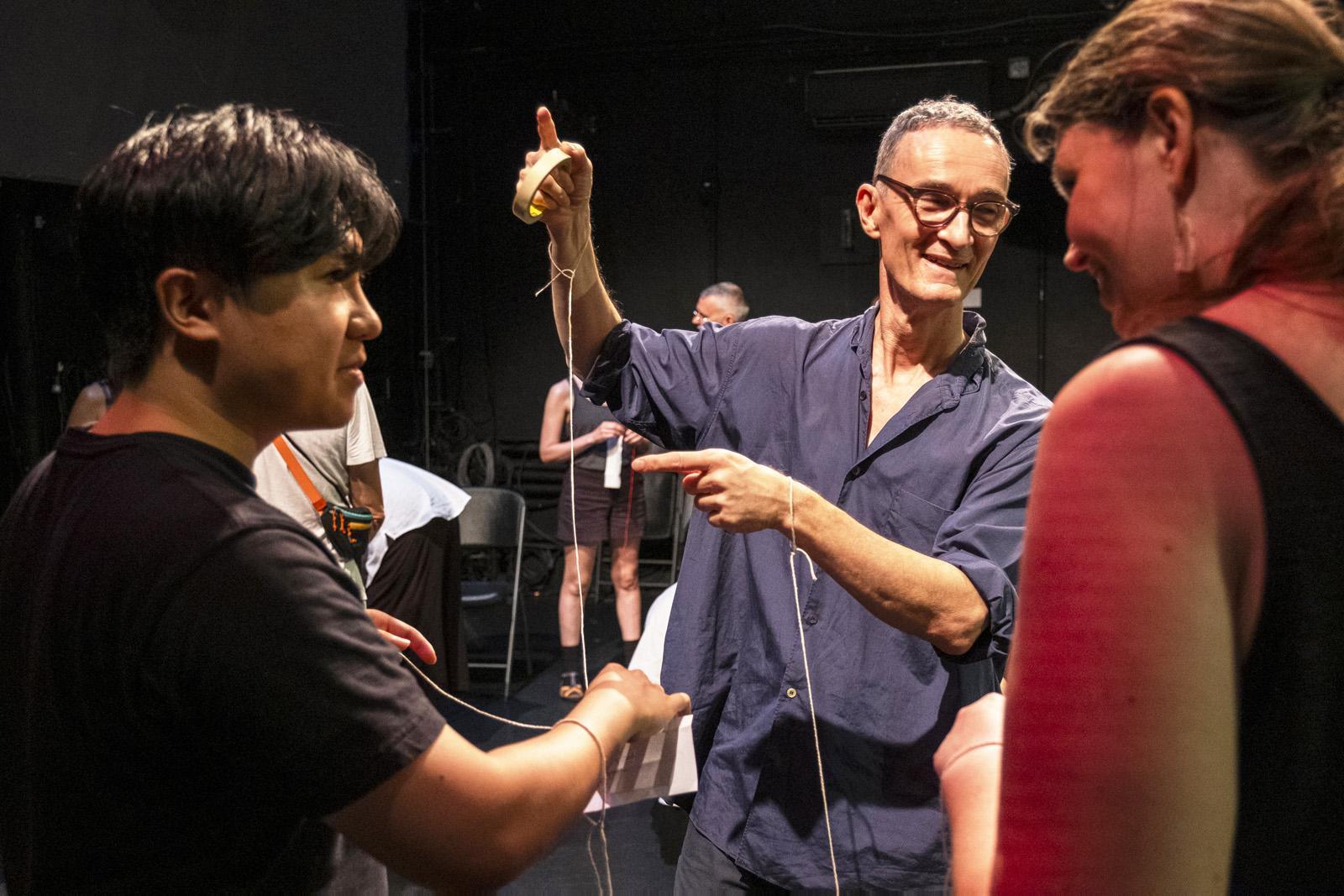
TASK is a marvelous, weird, tangled up project. It’s been running for over 20 years and I don’t see it slowing down anytime soon. Why? Because it is super straightforward, exceptionally fun, and a fantastic, artistic demonstration / performance / enactment of how we are all connected and live in contingency with each other.
TASK has a very simple set of rules: you gather a group of people in a space. There is a box in the center of the room labeled “TASK.” The room has some art supplies or materials, which can be as simple or complex as you want. Every person in the room writes down a task they’d like accomplished by someone on a slip of paper and adds it to the box. Each person picks up someone else’s task. Once you accomplish your task, you write another one down for someone else to accomplish. That’s it.
What is remarkable is not the set of rules—nearly as simple as throwing a ball of yarn between people in a circle— but rather what emerges. In our iteration of the project, we had people jumping as high as they could and speaking very loudly in the room. There were crazy masks made, karaoke sung between people, string-and-tape body outlines on the floor, large letters filling the walls, a little house built out of construction paper, three paper airplanes thrown into the room, a performative interruption from the pulpit of the entire game, and—very memorably—a conga line in which we all danced. There are a lot of great photos and some amazing memories.
But what’s most relevant here—and how the topic of tangle helps me to understand the world a little better—are the ways in which the project embodies and plays with our basic dependency on others. Each task is a request for someone else. Each time one is accomplished, it’s replaced with another task. The tasks are anonymous, non-reciprocal, and yet they connect us with each other. A room of requests that actually transform into gifts. Like in Lewis Hyde’s The Gift, these requests-cum-gifts almost immediately create a community out of what started as just a room of people.
After our session I asked Oliver if anyone had ever abused TASK. He replied that it’s happened a couple of times in twenty years but not so often. because everyone is bound by the same set of rules. Also, each task is ultimately enacted by someone else. If someone were to propose a dangerous or hurtful task, the person who picks it still has the latitude to interpret it. This additional filter offers a small microcosm of the ways that our asks—and our gives—shape ourselves and our world.
I’m finally starting to realize why this project appealed so much for this particular commission. TASK is a project that amplifies and exaggerates the myriad web of connections that connect us all. Through a very playful yet ultimately serious setup, the project takes the responsibilities we have to each other and transforms them into a source of joy.
My dear friend and collaborator Asad Raza has a phrase I love. An object is an excuse for a conversation, a game is an excuse for a relationship. Brilliant life philosophy in a handful of words.
Maybe that’s as good a way to wrap up this little tangle as any. Writing itself, a letter that is shared, a game with oneself and others. A set of myriad, spider web-like strands. And maybe with not one spider but many, all of us spun up in the gossamer webbing that is timeless and glassy eyed and slack-jawed—the experience of connection that is the pleasure of every speckled moment of this worldly life.
Thank you, as always, for the kind invitation to this. Even if I wasn’t quite sure about it, playing this game of writing to you both brings me towards a useful tangle of thoughts. Sending lots and lots of virtual love your way and hope to intersect IRL before long!
Love,
P.
Back to grid